

Atomic-Powered Rocket Tested in Jackass Flats, Nevada
Physics doesn't change. It just loses funding, Essay, 600 words, (3 minute read)

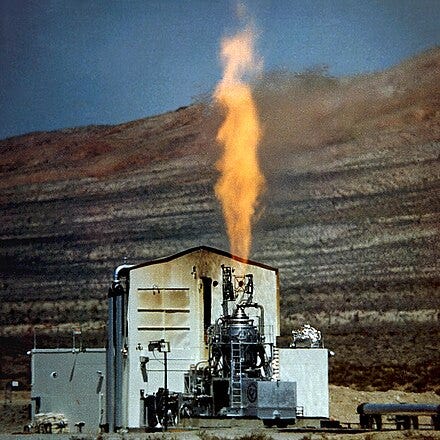
The 1960s were a different time. I was reminded of that the other day when re-reading a portion of James Mahaffey’s thoroughly enjoyable book Atomic Adventures. Chapter 5 of that work recounts the tale of Project Rover, and the KIWI rocket engine, which used hydrogen as a fuel and a nuclear fission reactor to build and test an engine that would get a craft to Mars much faster than a chemical rocket. The device was tested, as can be seen in the image.
The test site was located in the middle of nowhere at, colorfully-named, Jackass Flats, Nevada. An industrial-scale facility was built, with a rail spur to trundle the engine even farther out into the desert for firing. The device was pointed straight into the ground, the nuclear-heated exhaust directed at the sky.
The way KIWI worked was to shove nearly 100 lbs./second of cryogenic hydrogen slush through the middle of an operating nuclear reactor. The heat from the reactor core is transferred to the hydrogen, instantly melting and then vaporizing the hydrogen. The 2,000oC hydrogen was not at all happy contained within the reactor core, and exited through the conveniently-place rocket nozzle at high speed. Exhaust goes one way. The spacecraft goes the other. Theoretically.
Testing this concept was...tricky. The biggest hydrogen tank farm in the world (1 million gallons) was built to feed the beast. A leak in 1962 resulted in the world’s largest hydrogen fire. The project advanced by running tests until the engine literally came apart under the enormous stresses. The broken parts were then re-engineered and replaced. Rinse and repeat.
Hundreds of millions of dollars fueled the project, along with an enormous volume of hydrogen. And it actually worked. There is every reason to believe that the technology can power a manned craft to Mars and other planets in a fraction of the time that chemical rockets would take. But Project Rover fell victim to budget cuts, and environmental concerns.
Every time the test engine failed, it would spew small pieces of the reactor core hundreds of yards out into the surrounding desert. That nasty debris needed to be recovered for engineering failure analysis. And, it was a bad idea to leave highly radioactive bits of uranium laying around in the open, even if the area was fenced off. A remote-controlled cart with a powerful vacuum cleaner device was built and tried to suck the hot chunks up. But it didn’t work all that well. In the end, crews in hazmat suits scoured the site after each test run, with Geiger counters and long, long tongs to pick up the pieces and deposit them in lead buckets. The “final” environmental clean-up cost nearly $1 billion.
Despite the ignominious end to Project Rover, the technology was sound, and remains so. Although, it’s probably better suited to ships which are already up in space. Fewer radioactive chucks littering the landscape that way. Maybe SpaceX or Blue Origin will dust off the moldy, old government reports and use the concept to propel us to Mars and beyond...I sure hope so.
More fascinating details to this tale can be found in chapter 5 of Mahaffey’s book, Atomic Adventures, and the Wikipedia entry on Project Rover.
Check out my novels at Novus Mundi Publishing, or just order them directly from Amazon:
A Grand Imperial Heir (sequel to A Grand Imperial War)
And visit my website, https://raytabler.com/, for Science Fiction You Can Enjoy!
An interesting bit of history. Fascinating technology, though not real eco friendly.