

Connections and World Building
A higher standard than reality

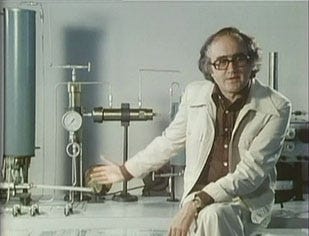
When I was a teenager, there was a wonderful show on. At lest I thought it was wonderful. Being entranced by things which most people view as mildly interesting, at best, is a common experience for nerds. I’m referring to “Connections,” a British TV show which followed how one idea spawns another, and another, and another, until we end up with our modern world.
Connections may well represent peak British television, and perhaps peak US public television (where it ran here in America). I never missed an episode. Of course that was back in the day before home VCRs, when if you missed the airing of a show you had to wait for the summer reruns or never see that episode ever again.
James Burke hosted Connections, stylishly attired as you can see in the photo above in an earth-tones leisure suit. Full disclosure: I worked in a polyester factory for a while. So I keep a warm spot in my heart for the leisure suit, fashion dinosaur though it is.
Every episode traced how one idea leads to the next. One traced the invention of the plow to how our modern world is so interdependent that a small power failure in 1965 cascaded into a blackout of New York City. Another starts with a test for the purity of gold, and ends up with the invention of nuclear weapons. Each time there is a long, and twisting, chain, but the connections are there.
What does this have to do with writing and world building, for all flavors and breeds of speculative fiction? Watching Connections opened my eyes to the complexity of the real world, how it all fits together even if we don’t see those strings at first. A writer will never be able to duplicate that complexity in created worlds, no matter the research and effort poured into the attempt. However, the closer you can get, the more real your fantasy world will feel.
Mark Twain is reported to have said that truth is stranger than fiction, because fiction has to make sense. That is true. But reality does indeed make sense. It just may not make sense to us. Perhaps twisted chains and unlikely facts are just little practical jokes and Easter eggs God left for us to find. But, since we know that another human wrote a piece of fiction, we impose a higher standard of rationality upon that human than we do upon God. Isn’t that ironic?
That is why it’s important to construct a reasonable, believable world when we go to build a fictional one. The more detailed and sensible a fictional world is, the more likely the reader will slip into it , like sliding into a nice warm bath. Of course, an interesting and entertaining story, and believable, compelling characters help too. It’s best to have all of these elements.
By “sensible” I mean a world that makes sense, as opposed to a sensible world. If the reader wants a sensible world, he wouldn’t bother with speculative fiction. Sensible, in this context, precludes developments which likely wouldn’t play out. In history, European exploration across oceans was driven largely by the desire to find another way to trade for east Asian goods (spices, silk, etc...). That shaped our modern world, but probably wouldn’t have happened if the silk worm and cinnamon trees grew in France and Spain.
In Game of Thrones, the indigenous people of Westeros were pushed north by settlers from other continents. Which sets up the eventual conflict between those settlers and the creatures those displaced created. In the Foundation series, a scholar discovers a way to predict the future, and struggles to preserve civilization in the midst of an approaching collapse. In Lord of the Rings, Sauron’s thirst for control, of everything, drives his repeated returns and the resulting wars.
These situations did not arise overnight. They were hundreds, or thousands of years in the making. Just like the twisted, unlikely chains explored in the Connections show.
Connections was a great show and always well written. The openings were textbook examples of how to hook people and reel them into the narrative.