

Henchmen and Sidekicks
Unsung underlings. Essay. 1000 words, 5-minute read.

Henchmen and Sidekicks
By Ray Tabler
Everybody needs a friend. That goes for both heroes and villains. Maybe even more so for bad guys than good guys. Because the bad guys are going to lose before the credits roll. They need a shoulder to cry on. Or more likely someone to rant to, as they plot revenge. That friend is called a sidekick, for the hero, or a henchman, for the villain.
Usually, there’s just one sidekick per hero, although there can be more. The hero and the sidekick are best buddies, or a mentor/protégée relationship. The villain/henchman dynamic is a bit more complicated, if not downright problematic, bordering on codependent.
First of all, neither relationship, hero/sidekick or villain/henchman, is an equal one. In both cases, one’s in charge, and the other isn’t. The hero/sidekick affiliation is usually cordial and consensual. Villain/henchman is almost always extremely hierarchical and typically abusive. That is probably due to our modern sensibilities, which view equality as positive, and hierarchy as a sometimes-necessary evil.
The sidekick is sort of an apprentice hero. Think of Batman and Robin, the Green Hornet and Kato, the Lone ranger and Tonto, or Xena and Gabrielle. (Okay, there’s a lot more going on between Xena and her sidekick. But that’s a whole other essay.) The hero is training up his replacement, for when he hangs up the cape. In contrast, the villain is jealous of his power, and paranoid as head bad guy. He looks upon his henchmen, even the long-serving and loyal ones, with suspicion and keeps them as interchangeable as practical. It’s a matter of job security.
It’s interesting to look at how sidekicks have changed over the years. Don Quxote’s squire and sidekick, Sancho Panza is by definition of a lower social class. He knows his place and stays there. Sam Gangee starts off as Frodo Baggins’ gardener, a very traditional English arrangement between gentry and yeoman. That evolves over the course of the story, but is always there in the background.
The Blackadder and Baldrick sequence is particularly illustrative. Blackadder is a British TV show, which follows a succession of members of the Blackadder family, as they cynically, and unsuccessfully, scheme their way to wealth and power throughout history. And Blackadder always has a member of the Baldrick family to do his dirty work. Baldrick enjoys a slow, unsteady rise in social status throughout the centuries. Of course, it’s difficult to classify Baldrick as henchman or sidekick. He displays aspects of both. Just as Blackadder straddles the line between villain and hero.
Although Sherlock Holmes and Dr. Watson are of roughly the same social class, Holmes’s genius effectively sets him above Watson. For this reason, Watson is the sidekick. Although, I’m not sure the Dr. sees it that way.
Many heroes and their sidekicks are law enforcement officers, or at least vigilantes. Marshall Matt Dillon and Deputy Festus Haggen anchor one end of this spectrum. The other end is crowded with dynamic duos who operate in the shadows of the law, dispensing unofficial justice. Batman and Robin, the Green Hornet and Kato, and the Lone Ranger and Tonto are lawmen without a badge. An animated parody of the Lone Ranger was Sheriff Quick Draw McGraw, plus his faithful sidekick Baba Looey. Quick Draw also had a secret identity as masked vigilante El Kabong. Baba Looey was El Kabong’s sidekick as well. Which was a dead giveaway. But nobody in the cartoon ever seemed to figure it out.
Pirate captains and their right-hand men provide a fascinating case study. Peter Pan’s nemesis, Captain Hook, was served by his 1st mate, Mr. Smee. Despite Hook and Smee’s comical incompetence as pirates, they definitely fall into the villain/henchman category. Because Hook’s personality is irredeemably evil. In contrast, Captain Jack Sparrow, and his sometimes-mutinous sidekick Mr. Gibbs, repeatedly wriggle free from the bad guy label. Sparrow wants to do the wrong thing. But his troublesome heart of gold and cruel fate trap him into being a reluctant hero, dragging Gibbs along.
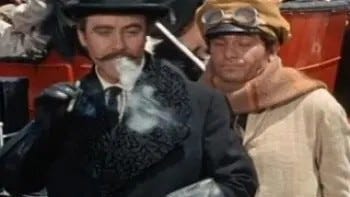
Another morally gray villain/henchmen pair is that of Professor Fate and his long-suffering minion Maximillian Meen in The Great Race. Set in the early 1900s, the movie follows an around-the-globe automobile race. Fate is determined to win, and employs a series of suitably steam punk concealed engines of sabotage aboard his car, the Hannibal Twin-8. “Push the button, Max!” Fate commands to activate the various infernal devices. However, Max Meen is not above temporarily joining forces with the forces of good when Professor Fate needs rescue from a side plot captivity.
James Bond works alone. His sidekicks, when he has them, tend to get to get killed off. (You might argue that the Bond girls rate as sidekicks, but I’m going to ignore that entire line of inquiry. Feel free to pursue it yourself.) The Bond villains he goes up against also have to deal with high turnover among their henchmen. Odd Job, Red Grant, Tee Hee Johnson, Nick Nack and others all came to grief trying to subtract 007 from the picture. However, a couple of Bond henchmen survived. Baron Samedi survived to make a brief, enigmatic appearance right before the credits rolled in Live and Let Die. Probably had a lot to do with him being a voodoo spirit in human form. The gigantic, steel-dentured Jaws fights tiger sharks to survive the end of The Spy Who Loved Me, and returns for revenge, employed by a new Bond villain in Moonraker. Then, Jaws falls in love, and repents to save Bond in the end. Quite the plot twist.
Dr. Who and his long, long list of companions is a much more complex subject than can be addressed in this short essay. I will point out, though, from the Daleks’ point of view, they’re all henchmen, not sidekicks. Something to think about…
Dracula had his Renfield. Dr. Frankenstein had his Igor. Just as Yogi Bear had his Boo Boo, and Fred Flintstone had his Barney Rubble. The henchman/sidekick character lies somewhere in the messy middle between buddy and craven underling. Strangely enough, the henchmen are most interesting, in my humble opinion. They must see something worthy of loyalty, way deep down beneath all that evil. Makes me want to find out what.
END.
Shameless Self-Promotion Section:
Check out my novels at Histria Books https://histriabooks.com/product-tag/ray-tabler/ and on Amazon https://www.amazon.com/stores/Ray-Tabler/author/B09H62RZB9
The Diesel-Powered Starship (due for release in September 2025) https://histriabooks.com/product/the-diesel-powered-starship/
A Grand Imperial War (Book 1 of the Grand Imperial series) https://histriabooks.com/product/a-grand-imperial-war-grand-imperial-series-book-1/
A Grand Imperial Heir (Sequel to A Grand Imperial War) https://histriabooks.com/product/a-grand-imperial-heir-grand-imperial-series-book-2/
Fool’s Paradise https://histriabooks.com/product/fools-paradise/
And visit my website https://raytabler.com/ for Science Fiction You Can Enjoy!
"Henchman" as a term originated in Britain in the 18th century- it specifically referred to an associate of criminals who was required to provide horses as a means of escape from the scene of the crime (later replaced by the "getaway" car in the automobile era). So, in essence, it means a villain's accomplice and continues to be used in that fashion, although in more recent years the gendered aspect of the name has been removed to allow women to "hench" more easily.
Having encountered more than my fare share of henchman and sidekick relations in animated films, I can safely say, as you have here, that they are complicated things. What we are doing externally is labeling these people based on what their "jobs" seem to be, but they rarely specifically conform to the label as we wish.
(BTW: "The Great Race" is an excepional film).