

Longevity And What to Do with It
The times, they are a changing

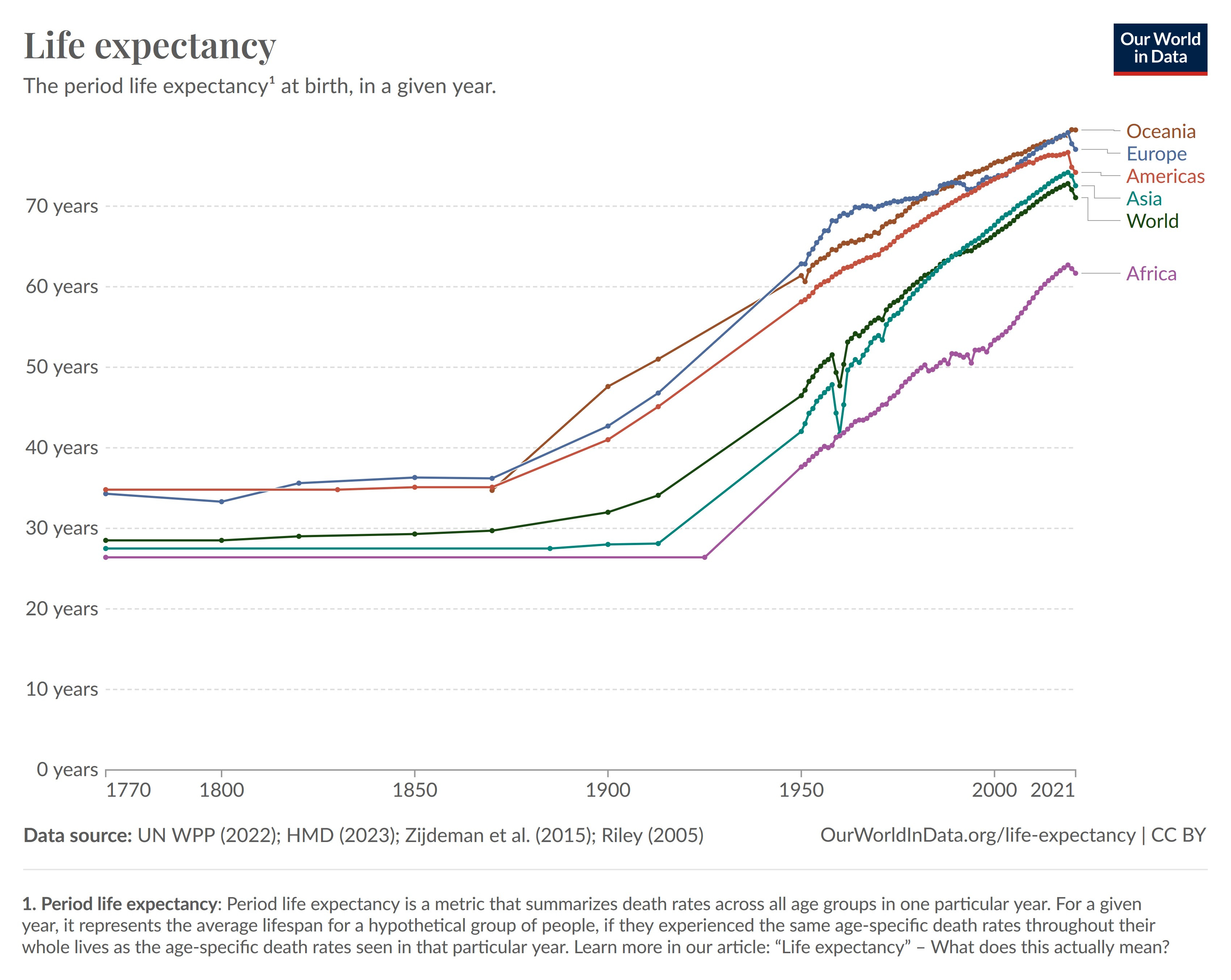
The world is getting older. Specifically, humans are living longer than ever before. That is a direct result of science, technology, and generally the spread of looking into how the universe works, writing that information down, then repeating the process. People, who usually want to live longer, have altered their behavior to make that happen. And it has.
The above chart tracks the rise in life expectancy the last 200 years. It’s a dramatic result. For almost all of human history, and pre-history, living past 35 or 45 was beating the odds. Then we clever, little monkeys figured out how to stack the deck in our favor. Which has thrown a monkey wrench into some well-established social mechanisms. Simply put, we old people are hanging around like a bad smell, and our cultures haven’t yet figured out how to deal with the situation.
This essay isn’t going to address the larger issues of restructuring social security, declining birthrates, or shifting healthcare needs. In the first place, nobody would listen to my views on these subjects. In the second place, I don’t really have any solutions to advance anyway. If I had to guess, we’ll probably try a half-dozen silly, unworkable ideas, which are actually just disguised pyramid schemes designed to make a few people rich, before stumbling on a halfway feasible answer by pure, dumb luck. That’s the way human civilization works best. Don’t believe me? Read some history. Then laugh, or cry, depending on your outlook.
The focus of this rambling screed is more of a myopic nature. What the hell will you, personally, do with the extra living time living in the modern world has gifted you?
Our working world seems to be lagging behind the rest of us. When I started my first grown-up job, the paradigm of working for the same company until they handed you a gold watch at a farewell dinner was in full force. That has changed, to put it mildly. Understandably so, because when that system was founded, most workers wouldn’t even reach retirement age. Those that did weren’t likely to hang around long either. Just check the chart. The golden years were not built with the carrying capacity modern medicine is selling leases for.
Of course, corporations solved the problem, from their point of view, by reneging on pension plans as fast as legally allowed, then jettisoning older workers before they could start getting their hips and knees replaced. I, myself, have been laid off twice. It’s a shock. And I confess to difficulty in seeing things from the corporation’s point of view at the time. Or now, truth be told. Fine. Bean counters are going to count beans, at the cost of all other activities; product quality, customer service, long-term company health, or workforce trust and well-being included.
There’s no use whining about changing conditions, as viscerally satisfying as it might be. People are living longer. Traditional business models can’t cope with the situation, and have chosen to cling to a shrinking status quo by tossing older workers out the rear of the bus before they can collect pensions and benefits. This is rather short-term thinking, as younger workers will notice the distinct lack of loyalty from corporations, and doubtless return the favor.
So, we must face up to reality ourselves. The paradigm of a care-free, comfortable retirement, financed by a grateful corporation, has collapsed, largely due to advancements in medical science extending lives. While unsettling, I prefer a longer, more uncertain life to a comfortable, early grave. Maybe I’m unusual in that regard.
There are websites which will predict the age at which you will die, with the input of some questions about health and family history, and the benefit of actuarial statistics. An interesting calculation, once you get past the morbid nature of the exercise. Statistically speaking, I might have another 30 years to take up space and annoy my relatives. That’s enough time to start and pursue an entire 2nd career. And that is exactly what I’ve embarked upon.
Not long after my 2nd, forced, early retirement, a colleague ask me if I was still writing. I told her I wasn’t. But I suddenly couldn’t figure out why not.
For many, retirement largely consists of a search for tee times, and places with a senior discount, interspersed with the quest to empty McDonald’s bottomless coffee cup. Fun enough, but likely to pall if you keep it up for 30 years. Being cheap, I cast about for a way to fill the time on a shoestring. Writing fits the bill. All you really need is a laptop and a steady supply of coffee, or tea.
I sat down and wrote a novel (A Grand Imperial War), as opposed to the short stories which had scratched the itch since I was 40. That took most of a year, but I was surprised how smoothly the words flowed. Also, there was a pandemic underway. So, there wasn’t much else to do. I self-published that one, and was partway through another (Fool’s Paradise) before an old publishing acquaintance told me he wanted to publish the first one. As it turns out, writing is somewhat addictive. I have a 3rd novel published (A Grand Imperial Heir, sequel to Grand Imperial War), and a 4th (The Diesel-Powered Starship) in the early stages of publication. Two more wait, written and on the conveyor-belt feeding the editing grinder. Writing itself is fun. Getting read is painful, complicated, and best left for another piece.
This has been my solution to the additional time modern medicine has handed me. And. I’m not complaining. I’d much rather live today than eke out the grim existence my ancestors must’ve endured; scratching out crops from stingy soil, fleeing from invading marauders (or the retainers of my own aristocracy), coughing out my last from pestilence. Probably all three in sad succession.
But I have a wrinkle to point out. Look at the chart of life expectancy. From about 1860, it’s a steady climb, a line with constant, positive slope. That’s over 100 years of persistent improvement. There’s no reason to expect that to change. How much further will science and medicine extend our lives? I, for one, have a feeling that it won’t stop.
True, there’s a school of thought that contends the human body has a built-in expiration date. an inherent upper limit of about 120 years. That might be the case. But I wouldn’t bet on it. Others disagree. Doctors and scientists have showered humanity with wondrous gifts. Still, never forget. What comes out of a scientist’s mouth is based upon what they know for a fact. And, the simple fact is that they, or we, don’t know everything. That is the whole point of research, truth be told. Undiscovered truths lie in wait for scientists who venture too far ahead of what we know to be so. After all, when railroads were first getting started, the scientists of the day warned that traveling by rail could cause instant insanity. traveling faster than 20 miles per hour would be fatal because human lungs would be incapable of drawing enough breath from the passing wind. And that a woman’s uterus would fly out of her body at speeds in excess of 50 MPH. Empirical observation proved otherwise.
What’s going to bring us those extra years? Damned if I know. Which doesn’t mean they’re not coming. In fact, I have a gut feeling they are. In the past, when humanity has encountered a limit, we find a way around it. Scientists wonder why the limit is there. How does it work? Answering that question takes you halfway to finding a loophole. Then, you’re crossing the ocean, communicating across thousands of miles, flying through the air, and living longer than anyone thought possible. Betting against human ingenuity is a losing game.
When will that breakthrough come? When will medical science find the fountain of youth? I couldn’t say. But it is coming. Maybe not in time for me to benefit. And, maybe it’ll be announced next week. Things are sure to change at that point. We’ll all have extra decades, maybe even extra centuries, to play around with.
Maybe we should start thinking about how to spend them. Second careers? Third or 4th careers? What happens to inheritance laws? What happens to the life insurance business? Does the 80 years it’d take to get to Alpha Centauri (at 10% of light speed) become more appealing if you can live to see the end of the trip? And the return journey? Ack! What if I live past the date when my books enter the public domain, and stop paying royalties? Suddenly, this extended longevity thing isn’t so attractive.
Interesting reading, Ray. I like your humor. I believe we may have rubbed elbows before in a sci-fi group on Facebook. Anyway, I’m digging into your substack now…
You may be interested in reading my recent essay on immortality, as proposed by Ray Kurzweil in a transhumanist context: singulardream.substack.com/p/immortality-and-its-malcontents