

Patterns and Purposes
There's more there than meets the eye.

Opening the Substack app is lot like a box of chocolates. You never know what you’re going to get. I suppose that makes me Forrest Gump, only without the history-adjacent back story and the Bubba Gump millions. Basically, if you invite people with something to say, and give them more than 140 characters to say it in, they’ll astound you with all of the interesting stuff that results.
I normally stick to writing, and the painful business thereof. But often I tumble down rabbit holes as diverse as philosophy, travel, and obscure historical events. The other day, The Arts & Letters Daily Substack (https://substack.com/home/post/p-145166833?source=queue) lured me along the path to why and how animals develop patterns on their skin and fur. Alan Turing, who did as much as any other single individual to win World War II by cracking Nazi communications codes, developed a mathematical model of how living organisms spontaneously form patterns. This was the type of problem he tackled more or less because it interested him.
Turing constructed the equations which account for the initiation, spread, and eventual termination of what he called morphogens. Altering the parameters of the equations, and the properties they control, results in patterns we see in animal fur, and skin. Quite literally, how the tiger got its stripes and the leopard its spots. (To borrow a phrase from the article I read.) But also, how your hair parts, and the swirls of your finger prints. It all comes down to the mathematics, and how chance twists the knobs on that control panel.
The underlying math of naturally-occurring patterns is complex enough. Of a higher level of complexity is why. Why do we (living organisms) have spots and stripes, and even more complex patterns on or about our bodies? That is a question which demands more than reasoning from basic principle. Observation and experimentation are required as well.
The obvious assumption for patterns is camouflage, to prevent being eaten if prey or to facilitate eating of a predator. That is probably true in many cases. Tawny lions blend into the long grass. Tigers are hard to see in the jungle. Bunnies are nearly invisible against many backgrounds.
Without a doubt, camouflage is a driving force behind the patterns on animal exteriors. But there can be others. A case in point is that of zebras.
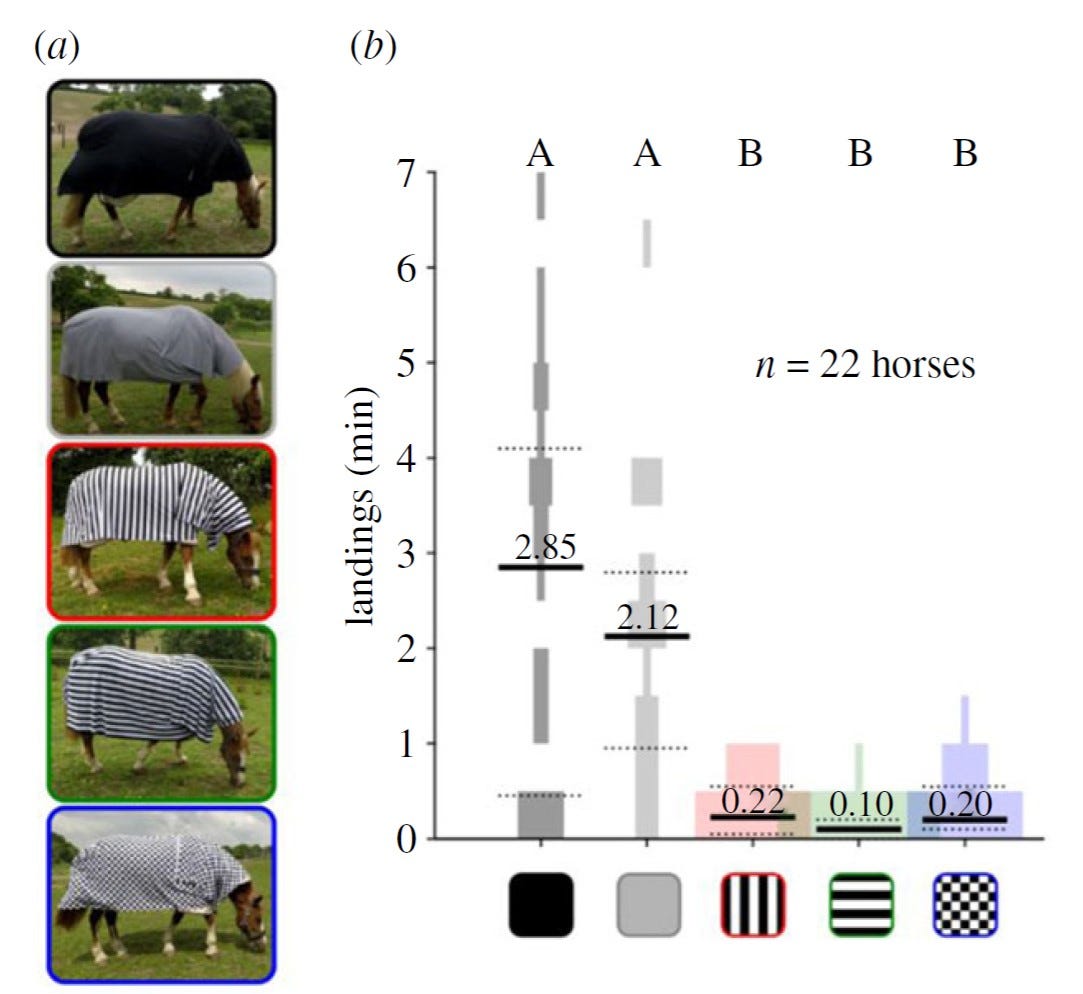
Studies show that the striped patterns in zebra hair confuses some species of biting flies. In short, the stripes freak the flies out so they won’t land or even fly near zebras. Looking instead for a meal on near-by wildebeests instead, supposedly. Scientists draped blankets of various patterns (striped and checkered) over horses, and measured the flight paths and landings of flies. The flies landed on the black and gray control blankets at a greater rate than the striped or checkered blankets. Presumably, those flies were greatly disappointed to find fabric on the menu instead of tasty horse flesh. Sort of like biting into a piece of wax fruit in the centerpiece of a dining table, I imagine.
The researchers postulate that the flies were the victim of something called the aperture effect, which interferes with the fly’s perception of what’s ahead of it. The fly doesn’t see the pattern as a solid surface, and avoids it.
Of course, it’s not that simple. Others have pointed out that a checkered pattern shouldn’t exhibit the aperture effect. But the flies are confused by checks as well. So, research continues.
How did this all come about? The astounding variety of patterns, and why, that is? Well, random evolution is the current odds-on favorite explanation. Think of it as a millions-of-year-long bingo game, with billions of balls in the tumble cage. Zebras do what zebras do, and every so often, a winning combination is drawn. At some point in the past, a stripey zebra was born, and that zebra didn’t get bit as often. Fewer fly bites must’ve been evolutionary advantaged, because now all of the zebras are so attired.
I really don’t know how long that evolution took. But maybe it happened quickly. Take a look at this little fellow who was recently born in Africa.
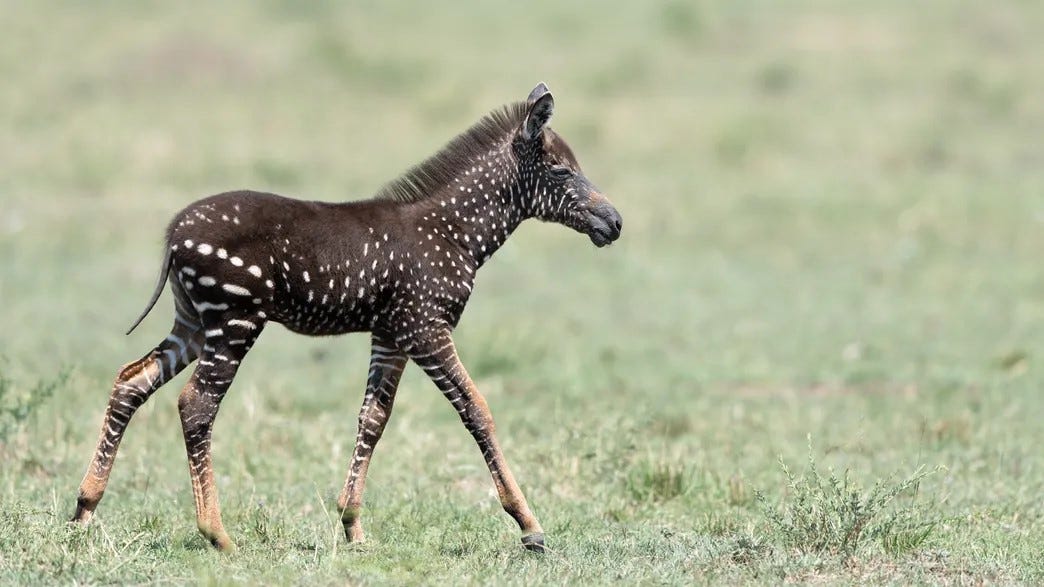
Will this unique zebra foal have to worry more about fly bites than other zebras? I don’t know. But my guess is that some natural protection will be given by the flies investigating selfie-snapping tourists instead.
Well there's another hypothesis on the evolution of the stripes which also has some research to support it, which is they are to help the zebra to hide among other zebras. If you're a leopard chasing your lunch it's important to keep chasing the same zebra until it gets tired. If the tired zebra gets back into the herd you're going to end up chasing a different zebra 🦓 still full of energy. Under this hypothesis the adorable spotty fellow is highly likely to end up as leopard 🐆 lunch.
...or it could end up being the zebra version of the Ugly Duckling....