
Sci-Fi Spinoffs
More story to tell. Essay. 700words, 4-minute read.

Sci-Fi Spinoffs
By Ray Tabler
Television production must be a funny place. There seems to be a sort of schizophrenia involved. The same people who will roll the dice on a totally unproven concept are the ones who will cling tenaciously to that idea if it comes up seven. Only makes good business sense, I suppose. And thus, was born the spinoff, a new TV show based to some degree on the last one. It’s like playing out a vein in a gold mine, following that paydirt through twists and turns. Some veins last a while. And some go bust right away.
This is an oft-told tale in conventional TV. All in the Family begat The Jeffersons and Maude, and The Golden Girls (in spirit). The Andy Griffith Show begat Gomer Pile. Happy Days begat Laverne & Shirley, and Mork & Mindy. NCIS begat a number of NCIS [fill-in-the-zip-code] series. Success is not guaranteed, however. Joanie Loves Chachi, AfterMASH, and The Brady Brides are all twisted spinoff wreckage along the road to ruin.
Today, though, we will focus on sci-fi spinoffs. And there are a few to pick from.
The great granddaddy of science fiction spinoff franchises is, of course, the Star Trek universe. Since captain Kirk originally went where no man has gone before, there have been a bewildering number of sequels, prequels, and tween-quels in that sandbox. After network bigwigs cruelly cut down Star Trek the Original Series in its prime, ardent fans resuscitated the franchise in the form of a motion picture. Gene Roddenberry, no fool he, started flinging out spinoffs like a Pez dispenser; The Next Generation, Deep Space Nine, Voyager, Enterprise… I’ve lost track TBH. Must be getting old. (Which is better than the alternative, I suppose.)
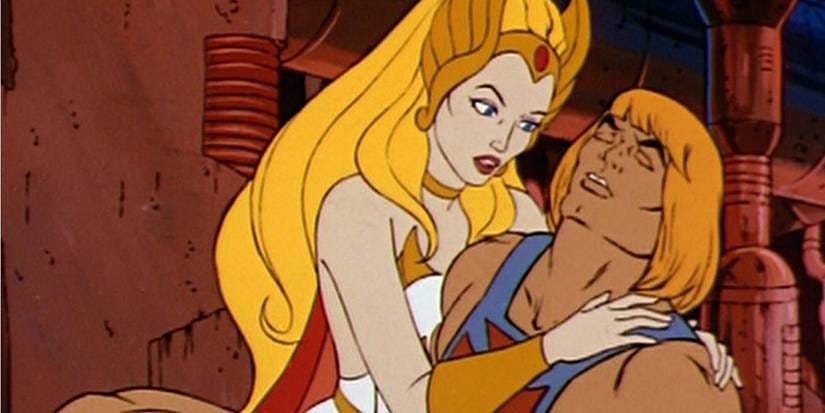
Angel was a spinoff from Buffy the Vampire Slayer. Xena Warrior Princess flowed from the Hercules, The Legendary Journeys show. She-Ra, Princess of Power came from the He-Man series, because, why not?
A common spinoff strategy is to draft off a successful movie franchise. Star Wars INC. has played that card numerous times. The movie Stargate birthed 3 popular spinoff series; Stargate SG1, Stargate Atlantis, and Stargate Universe. After a very good start, and 2 disappointing movie sequels, Highlander, the motion picture, spun off a pretty good series, featuring an immortal relative of the movie’s main character. An aspect of the Highlander universe is that all of the immortals have to fight each other, the winner beheading the loser. “There can be only one.” Don’t recall how Connor and Duncan resolved that conflict of interest. Must’ve made for tense family get-togethers.
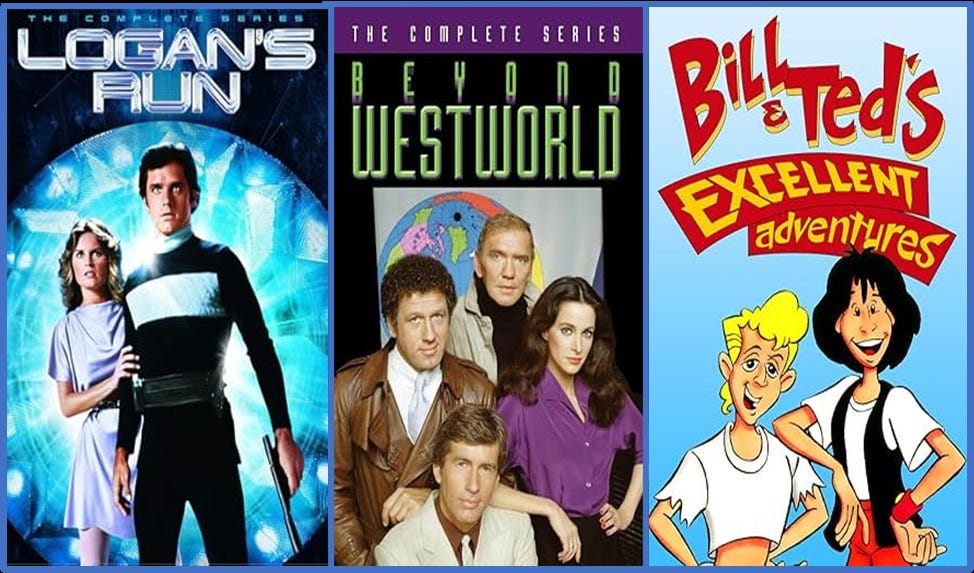
Just because the movie did well, doesn’t mean the spinoff series will. There have been TV spinoffs of Planet of the Apes, Logan’s Run, Alien Nation (which I personally really liked), Westworld (of the original 1973 movie), Total Recall, Minority Report, Timecop, Starman, Robocop, Bill & Ted’s Excellent Adventure, Weird Science, and Time After Time. Not that these shows were bad. Some were quite good, for the little money spent on them. Some were quite bad for all of the money spent on them. None of them lasted long. Which causes TV producers and executives to lose sleep. We in the viewing public are just that fickle.
What is the difference between a spinoff and a reboot? Good question. I suspect the dictionary definition is shrouded in what the producer pitching the idea for a show thinks will get greenlit. Ideally, a spinoff should be chronologically downstream of the original show, book, or movie, and may contain one or more of the same characters. But that is a rule made to be broken in service of drawing viewers.
Both Star Trek Enterprise and Battlestar Galactica Caprica take place before the shows which birthed them. Yet neither contain the same characters. Battlestar Galactica (2003) is technically a reboot of Battlestar Galactica (1979). Both “original” Battlestars (1979 & 2003) begat numerous spinoffs, two of which (an abortive 10-episode, 1984 BSG sequel, & Battlestar Galactica: The Second Coming) I was unaware of until this writing. Star Trek, The Next Generation is arguably a reboot, not a spinoff. Yet, all are considered spinoffs. I must conclude that the only hard and fast rule (besides trying hard to include “star” in the title) is: whatever works, and makes money. Not a bad rule to follow.
END.
Shameless Self-Promotion Section:
Check out my novels at Histria Books https://histriabooks.com/product-tag/ray-tabler/ and on Amazon https://www.amazon.com/stores/Ray-Tabler/author/B09H62RZB9
The Diesel-Powered Starship (due for release in September 2025) https://histriabooks.com/product/the-diesel-powered-starship/
A Grand Imperial War (Book 1 of the Grand Imperial series) https://histriabooks.com/product/a-grand-imperial-war-grand-imperial-series-book-1/
A Grand Imperial Heir (Sequel to A Grand Imperial War) https://histriabooks.com/product/a-grand-imperial-heir-grand-imperial-series-book-2/
Fool’s Paradise https://histriabooks.com/product/fools-paradise/
And visit my website https://raytabler.com/ for Science Fiction You Can Enjoy!
Sometimes the spinoffs really work. I'm a huge Star Trek fan and have seen all of the different series except the most recent ones that can only be seen on Paramount Plus. OK, I'm too cheap to pay for another TV service. I just rewatched 2 of the 3 Chris Pine Captain Kirk movies and number 3 is queued up for tonight. They are leaving Netflix at the end of this month.
In other cases spinoffs seem like the quest for more money and complete lack of anything resembling a new idea.
As always, we viewers take our wins when we can and hope the movie and TV show producers come up with a new idea now and then. Even better would be movies aimed at a mature audience....hint, not 15 year-old boys.
Thanks for sharing an interesting look at the TV and movies we've loved and hated.
Fascinating stuff. It appears that sf is particularly apt to spin em off.